
Hot rod donation
Donate a hot rod, and let us settle the title question first
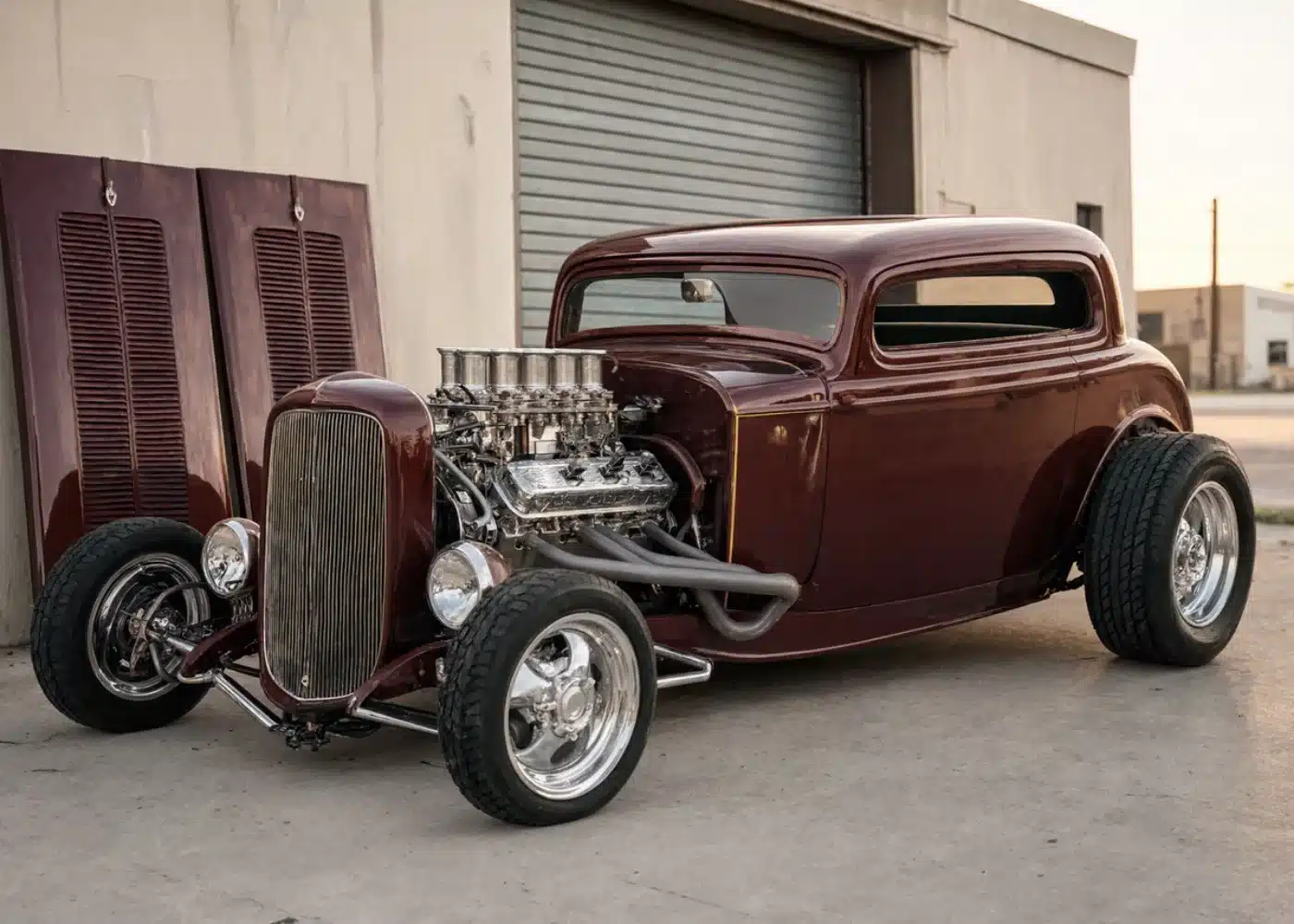
Hot rods are built, not bought, which means the paperwork rarely describes the car sitting in front of you. That is the first thing we sort out, because a beautifully built rod that cannot be legally transferred helps nobody.
Where donated rods come from
Builders who finished and moved on, and builders who ran out of time. Both are welcome and the numbers are very different, so we will tell you which yours is.
Estates. A hot rod in an estate is the hardest car for a family to handle: no guide value, frequently incomplete paperwork, and nobody who knows what was done to it or what it cost.
Owners who could not sell privately. Rods attract endless interest and very few real offers, and a lot of builders are done with that process.
What decides whether this can happen
Most rods are built on an original body and frame, a reproduction frame, or a mix. In most states the title follows the body or the frame VIN. If the frame was replaced with an aftermarket chassis and the title still describes the original, the paperwork and the car no longer match.
So tell us three things up front: what the title says, what the car actually consists of, and whether the VIN on the car matches the VIN on the title. If you have a title for a body and no title for the chassis, or a state-assigned VIN, or a specially constructed vehicle certificate, say so. Some states have a clear process for all of this and some do not.
We check your state before anything is scheduled. This is not looking for a reason to decline; it is avoiding the outcome where the car is collected and then cannot be transferred to a buyer.
What decides what a rod brings
- Paperwork. First and biggest. A clean transferable title outweighs any single build detail.
- Build quality and who did it. Chassis and body work, panel fit, wiring, brake and fuel plumbing. A known shop build is worth more than an anonymous one.
- Drivetrain. What engine and transmission, whether it runs, and whether it is a combination a shop can service.
- Finish work. Paint quality, flake, pinstriping, plating and upholstery are real labor and they do show up, though rarely at what they cost.
- Rideability. A rod that steers, stops and can be driven three hundred miles sells far better than a show car that cannot leave the block.
Marques and models we accept
Rods are built from named components even without a badge.
- Bodies and chassis: Ford Model A, Model T, 1932 through 1934 and 1940 Fords, Chevrolet 1937 through 1954, Willys coupes and pickups, plus reproduction bodies from Brookville, United Pacific and Outlaw, and chassis from TCI, Art Morrison, Pete & Jakes and Total Cost Involved.
- Drivetrain: Chevrolet small-block and big-block, LS and LT swaps, Ford flathead, Windsor and Coyote, Chrysler Hemi, plus Turbo 350 and 400, 700R4, C4 and C6, Tremec and Muncie.
- Known shops and components: So-Cal Speed Shop, Roadster Shop, Kugel, Vintage Air, Wilwood, Currie, Edelbrock, Holley, Stromberg.
Not seeing yours? The list above is a search aid, not a restriction. We accept any make or model in this category, named here or not, including orphan brands and builders long out of business. What decides a donation is the condition and the paperwork, never the badge, so put yours on the form even if it is not listed.
Manufacturer and model names appear here so you can find your own vehicle. No manufacturer sponsors, endorses or is affiliated with this program.
What you can deduct
A collector vehicle is titled and the title has to transfer. On older vehicles the paperwork is the most common obstacle: a title from three owners ago, a bill of sale and no title, or a title that does not match the VIN. Tell us exactly what you have before anything is scheduled. Some states have a bonded title or court-ordered process and some make it very hard; the state title rules page covers the general shape of it. Read the title section above first, because on a rod that is the deciding factor.
Giving Center sells the car and your deduction is the gross sale proceeds on Form 1098-C. A finished, titled, running rod with quality work regularly clears $5,000. Most land between $500 and $5,000, where Form 8283 Section A applies.
The honest part: money spent on a rod build is very rarely recovered on resale, and the gap is wider here than almost anywhere. Your deduction follows the sale, not the receipts. If the sale clears $5,000 the IRS requires a qualified appraisal plus Form 8283 Section B. On a vehicle whose value depends on originality and documentation, have it done by an appraiser who knows the category rather than a generalist. It is your expense and your decision, and the appraiser has to be independent of us.
Hot rod donation questions
The title is for the original body, but it is on a new chassis.
Tell us before anything is scheduled. Some states have a specially constructed vehicle or rebuilt inspection route and some do not. We check yours first.
I have sixty thousand dollars of receipts.
Understood, and build money is genuinely not recovered on resale. Your deduction is the sale proceeds. We would rather set that expectation now than in February.
It is a rolling chassis with the engine on a stand.
We will usually take it and the number will be modest. Tell us exactly what is assembled, what is loose and what is missing.
Does it need to be driveable?
No, but a rod that actually drives sells considerably better than one that has never been sorted.
Who built it? I do not know.
Look for a builder plaque on the firewall or frame rail, or a name on the chassis. It is worth five minutes; a known shop build is worth more.
Giving Center does not provide tax, legal or financial advice. Donations are deductible to the extent allowed by law. See IRS Publication 526, Publication 561 and Publication 4303, and consult a tax professional.