
Wheel loader donation
Donate a wheel loader when the yard it worked in has closed
Wheel loaders outlive the businesses that buy them. A gravel yard closes, a municipality replaces its fleet, a landscape supply operation consolidates, and a loader that still runs well is suddenly a 30,000-pound problem sitting on somebody's lot.
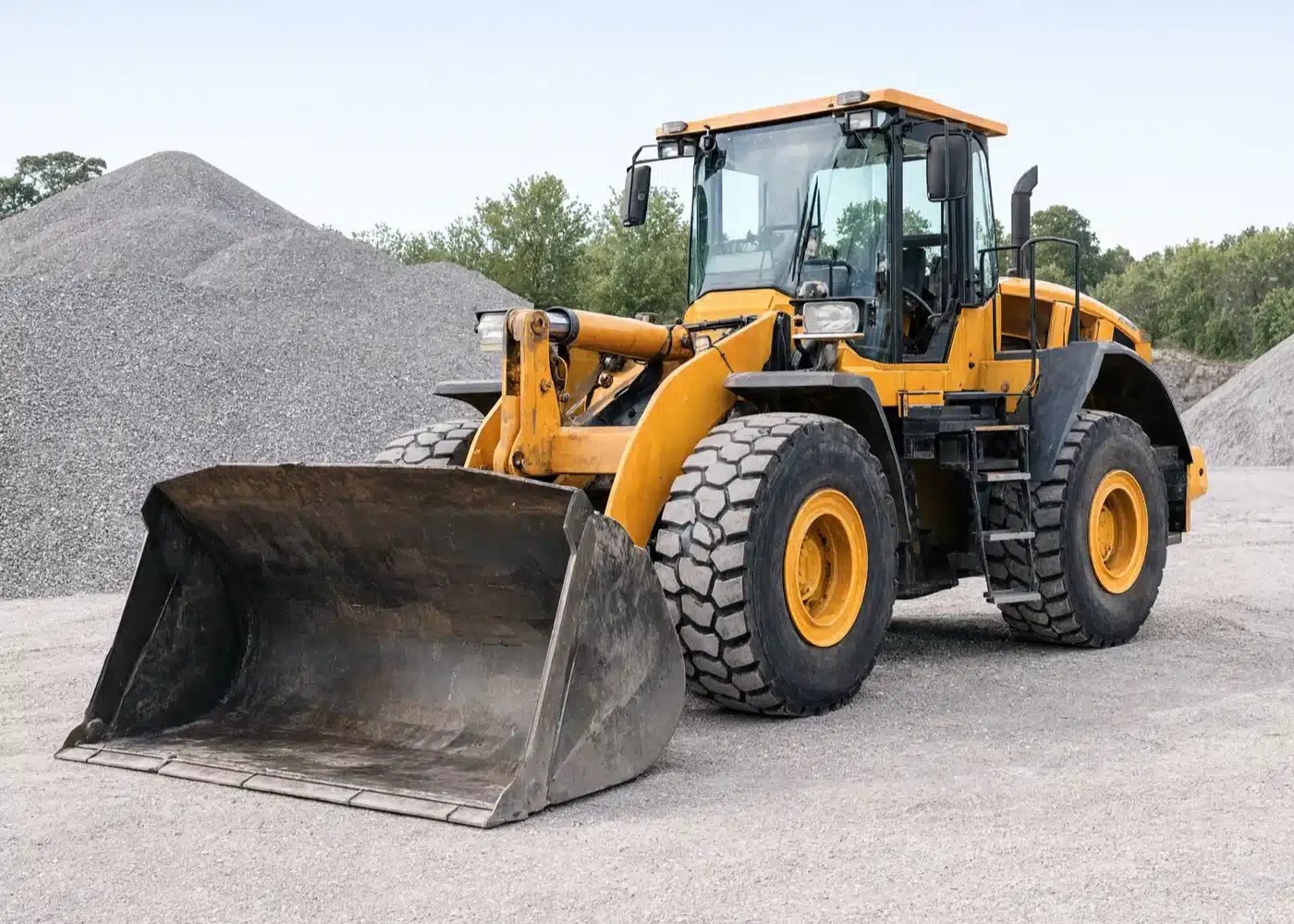
Where donated wheel loaders come from
Aggregate and landscape supply yards, small municipalities, and farms that bought a loader for feed and snow. In every case the machine is worth something and the owner has no channel to sell it that does not involve weeks of phone calls and a buyer who wants to negotiate on site.
Estates are the other common source. A loader in an estate is hard to divide and harder to move. Donating it produces one document and one date, which is what an executor actually needs.
Compact wheel loaders come to us from nurseries, stables and equipment rental yards. They are easier to haul and they sell quickly.
Lowboy, and sometimes a permit
A full-size wheel loader goes on a lowboy. Depending on weight and height it may need an over-dimension permit and a route that avoids certain bridges. Giving Center arranges the trailer, the permit and the route, and covers the cost.
We ask for the operating weight off the data plate rather than a guess, because the difference between a 16,000-pound compact loader and a 45,000-pound production machine is the difference between two entirely different trucks.
Bucket off or bucket on, either is fine, and we will tell you which after we know the machine. If it does not start, a winch load is still possible on most lowboys but the driver needs to know in advance. Tell us about the ground, too: a loader parked on soft fill after a wet week is a different job than one on a paved pad.
What decides what a wheel loader brings
- Size class. The 2 to 4-yard bucket range is the volume market. Compact loaders sell fast at lower numbers; very large production machines bring more but wait longer for the right buyer.
- Hours and drivetrain. Transmission and axle condition carry more weight than engine hours alone. A loader that shifts cleanly and holds a load is a working machine.
- Tires. A set of large loader tires is a serious expense. Good rubber is one of the clearest value swings on the whole machine.
- Attachments and couplers. Forks, a quick coupler, a second bucket, a snow pusher. Send them; they add to the sale.
- Leaks and pins. Loose bucket pins, leaking cylinders and a tired articulation joint are the faults buyers check. Photograph them; honest photos sell better than surprises.
Makes and models we accept
Loaders are shopped by make and model number, so have the data plate in hand.
- Full-size: Caterpillar 930, 950, 966 and 980, John Deere 544, 624 and 744, Komatsu WA series, Volvo L series, Case 621 and 721, Hyundai HL, Kawasaki, Doosan and Develon DL, Liebherr L series.
- Compact and utility: Bobcat, Kubota R series, Wacker Neuson WL, Volvo L20 and L25, Avant, JCB 407 and 409.
- Backhoe and integrated tool carriers: Caterpillar IT series, JCB 3CX and 4CX, Case 580.
Manufacturer names appear here so you can find your own machine. No manufacturer sponsors, endorses or is affiliated with this program.
The paperwork, and what you can deduct
Loaders are not titled. Ownership is proved by the purchase invoice, a bill of sale, a company asset record, or a lien release for a machine that was financed. Serial number off the data plate goes on the paperwork.
Giving Center sells the loader and your deduction is the gross proceeds, reported on Form 1098-C. Working loaders in the common size classes usually clear $5,000, which brings in the IRS requirement for a qualified appraisal plus Form 8283 Section B. The appraisal is a donor expense and a donor decision. If the machine sells for $500 to $5,000 you file Section A and skip the appraisal.
If the loader was a business asset and has been depreciated, run it past your accountant first. Business property donations follow different rules than personal ones.
Wheel loader donation questions
Do you take loaders that do not run?
Sometimes. A common model with a dead engine has value to a rebuilder or a parts buyer. A one-off machine that needs a lowboy and a winch may cost more to move than it returns, and we will say so instead of hauling it.
What if I do not know the operating weight?
The data plate has it, usually inside the cab door or on the frame near the articulation joint. Photograph the plate and send it with the form. If the plate is gone, give us make and model and we will look it up.
Will you take a backhoe loader instead?
Yes, and it has its own page: donate a backhoe.
Can you handle a machine in a closed quarry or yard?
Yes. We need a contact with keys and a window when a lowboy can get in and turn around. Send photos of the approach and we will plan around it.
Do I have to clean it out?
Remove personal property and any hazardous material. Beyond that, no. We do not expect a wash job and it will not change the outcome much.
Giving Center does not provide tax, legal or financial advice. Donations are deductible to the extent allowed by law. See IRS Publication 526, Publication 561 and Publication 4303, and consult a tax professional.