
Microcar donation
Donate a microcar, one of the few cars worth more than it looks
Microcars are the category most likely to surprise a family. A tiny bubble car that looks like a novelty can be worth many times what a conventional classic sedan brings, because the collector market for them is small, international and serious.
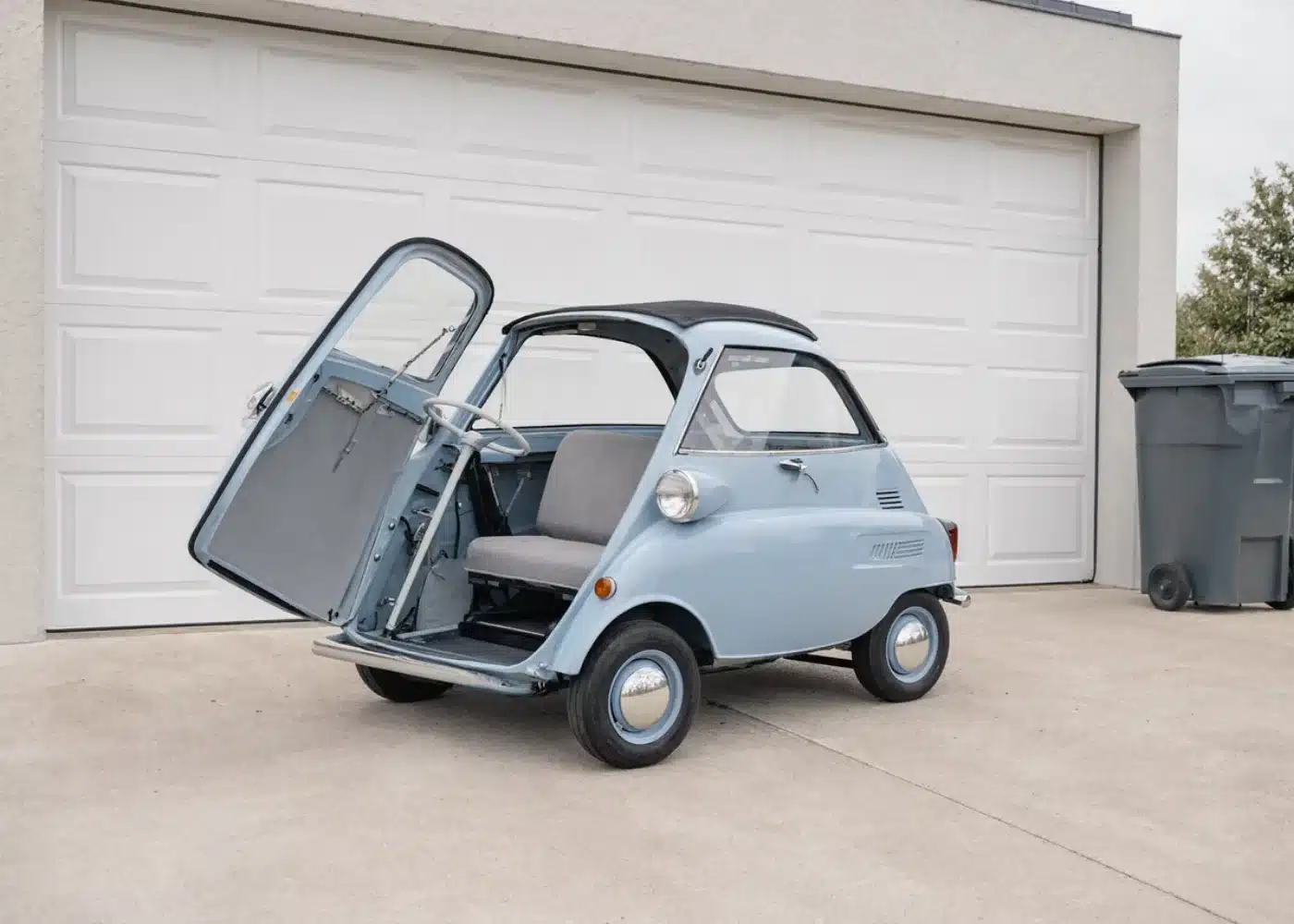
Where donated microcars come from
Estates and long-term collections. A microcar bought in the 1980s as a curiosity has usually appreciated substantially, and the family rarely knows.
Collectors thinning a group. Microcar collectors tend to own several, and when one goes it often goes to a donation rather than a private sale to avoid the tire-kicker problem.
Owners of imported kei cars and later small imports, which are a related but separate market from the 1950s bubble cars.
Small, light and easy
A microcar fits in an enclosed transporter with room to spare, and on the smallest ones a covered trailer is enough. Giving Center arranges and covers it.
It does not need to run. Tell us whether it rolls and steers. Many microcars have unusual steering and drive layouts and a few cannot be pushed in a straight line at all, so a photo of the underside helps.
Do not detail it, do not repaint anything and do not replace parts to make it presentable. Originality is the value here and fresh cosmetic work over honest patina can lower what it brings. Leave it as it sits and send honest photographs. On microcars, original paint, original interior cloth and original instruments are disproportionately valuable because reproduction parts largely do not exist.
What decides what a microcar brings
- Model and rarity. The dominant factor, and the range is enormous. Some models are worth ten times others of similar size and condition.
- Completeness. More critical here than anywhere else, because parts are genuinely unobtainable for most models. A missing instrument cluster or a missing door can be effectively unreplaceable.
- Originality. Original engine, original interior, original glass and trim. Restoration with incorrect parts lowers value in this market.
- Structural condition. Floors and the lower body. Many microcars have minimal structure and rust in the wrong place is serious.
- Documentation and provenance. Any history, original manuals or registration documents add real value.
Marques and models we accept
Model rarity drives everything, so identify it precisely.
- 1950s and 1960s bubble cars: BMW Isetta and 600, Messerschmitt KR175 and KR200, Heinkel and Trojan, Vespa 400, Goggomobil, Zundapp Janus, Fuldamobil, Peel, Bond, Berkeley, Frisky.
- Small European: Fiat 500 and 600, Autobianchi Bianchina, Citroen 2CV and Ami, Renault 4CV and Dauphine, NSU Prinz, DAF 33, Subaru 360, Mini.
- Kei and later imports: Honda N600 and Z600, Suzuki Cappuccino and Jimny, Daihatsu Midget and Mira, Autozam AZ-1, Mitsubishi Minica, Kei trucks of all makes.
Not seeing yours? The list above is a search aid, not a restriction. We accept any make or model in this category, named here or not, including orphan brands and builders long out of business. What decides a donation is the condition and the paperwork, never the badge, so put yours on the form even if it is not listed.
Manufacturer and model names appear here so you can find your own vehicle. No manufacturer sponsors, endorses or is affiliated with this program.
The paperwork, and what you can deduct
A collector vehicle is titled and the title has to transfer. On older vehicles the paperwork is the most common obstacle: a title from three owners ago, a bill of sale and no title, or a title that does not match the VIN. Tell us exactly what you have before anything is scheduled. Some states have a bonded title or court-ordered process and some make it very hard; the state title rules page covers the general shape of it. Microcars are frequently imports and the import paperwork matters: a car brought in privately without complete documentation is much harder to title and therefore to sell. If yours was imported, tell us what came with it.
Giving Center sells the car and your deduction is the gross sale proceeds on Form 1098-C. A complete original microcar of a desirable model clears $5,000 comfortably and rare models go far past it, which means a qualified appraisal and Form 8283 Section B are required at your expense.
An incomplete car of a common model can land between $500 and $5,000. This is genuinely the category where a marque-specialist appraisal is most worth having, because a generalist appraiser is very likely to undervalue a microcar substantially. If the sale clears $5,000 the IRS requires a qualified appraisal plus Form 8283 Section B. On a vehicle whose value depends on originality and documentation, have it done by an appraiser who knows the category rather than a generalist. It is your expense and your decision, and the appraiser has to be independent of us.
Microcar donation questions
It is tiny and looks like a toy. Is it worth anything?
Possibly a great deal. Microcars are the most commonly undervalued thing we receive. Tell us the exact model before you assume anything.
It is missing the instrument cluster and one door.
Worth disclosing carefully, because microcar parts are largely unobtainable and missing items hit value harder here than in any other category.
Should I have it restored first?
No. And specifically, do not restore it with incorrect parts, which is the usual outcome and actively lowers value in this market.
Mine is an imported kei truck.
Handled here. Tell us the import paperwork situation, because that decides whether a buyer can register it.
Will a normal appraiser get this right?
Frequently not. If you are claiming over $5,000 it is worth finding an appraiser who knows microcars specifically, because generalists routinely undervalue them.
Giving Center does not provide tax, legal or financial advice. Donations are deductible to the extent allowed by law. See IRS Publication 526, Publication 561 and Publication 4303, and consult a tax professional.