
Grain drill donation
Donate a grain drill after the small grains came out of the rotation
Grain drills last a very long time and they get replaced by practice change rather than wear. A drill that seeded wheat for thirty years still works, and there is a steady buyer market among small grain growers, cover crop seeders and pasture managers.
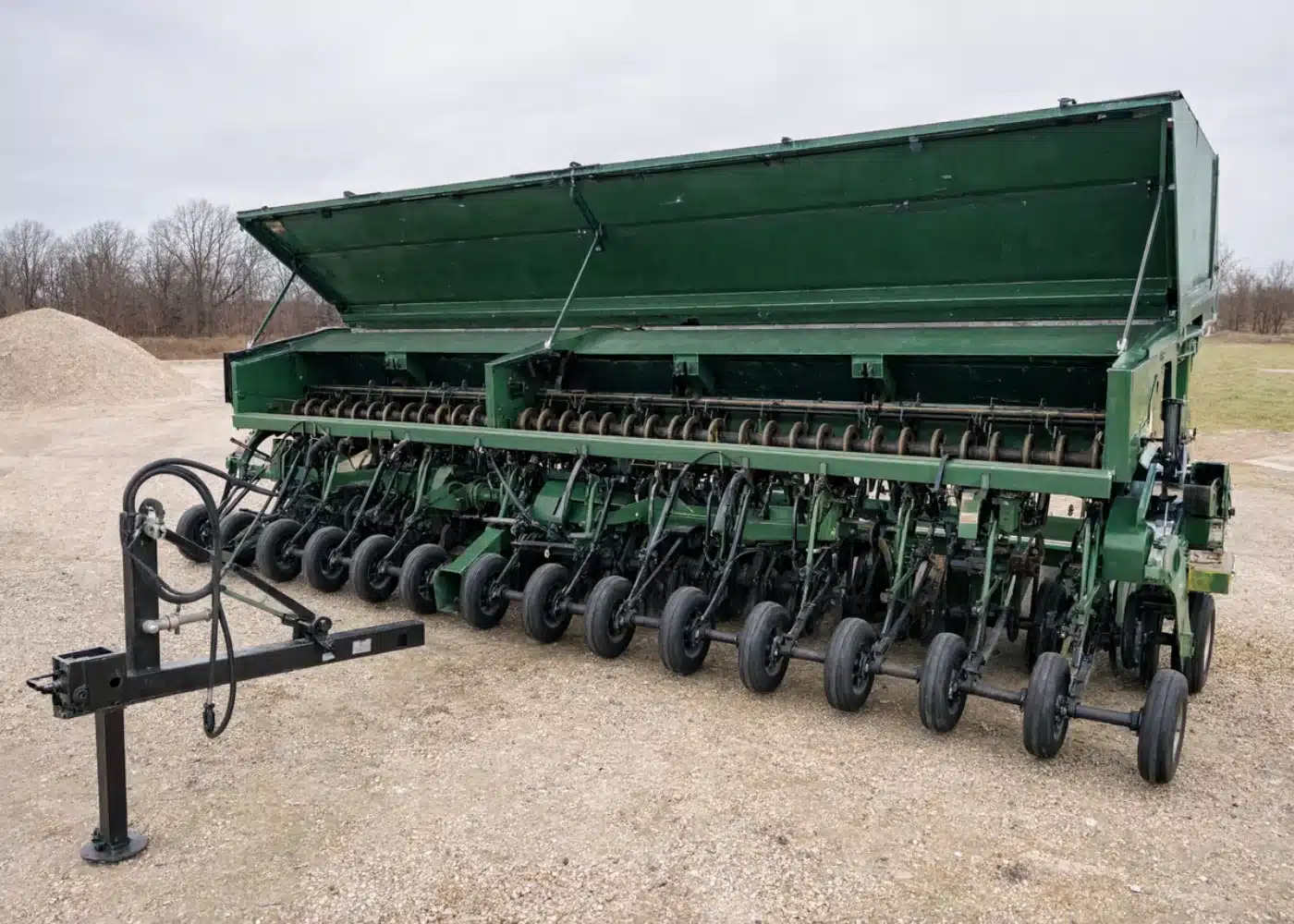
Where donated drills come from
Farms that dropped small grains from the rotation. A drill becomes surplus overnight when the rotation changes and it will still be perfectly functional.
Estates and farm dispersals. A drill is almost always in the lot, and an old box drill is one of the items families most often assume is worthless.
Operations that moved to a no-till drill or an air seeder and no longer need the conventional box drill.
On a trailer, folded if it folds
A conventional box drill goes on a tilt-deck or drop-deck. A large no-till drill or an air seeder with a cart is heavier and longer and needs a step-deck. Giving Center arranges and covers it.
Tell us the working width, whether it folds, and whether the transport wheels roll. Also tell us if it is a drill plus a separate air cart, because that is two items and two loads.
Empty the seed boxes completely and tell us whether any treated seed remains. Leftover treated seed is a disposal issue and that cost comes out of the proceeds. Access is the first question on any farm pickup. Tell us where it sits, what the ground is like and what is between it and a road a trailer can use.
What decides what a drill brings
- Type. Conventional box drill, no-till drill, or air seeder with a cart. No-till drills are worth substantially more and have the deepest market.
- Working width and row spacing. The defining specs.
- Opener condition. Disc openers, hoe openers or shanks, and the bearings behind them. On a no-till drill the openers are most of the value.
- Seed cups, delivery tubes and the metering drive. Cracked tubes and worn cups are cheap to fix and worth listing accurately.
- Press wheels and small seed box. Press wheel condition, and whether a small seeds or legume box is fitted and works.
Makes we accept
Buyers name brand, width and opener type.
- No-till drills: Great Plains 1006NT, 1500 and 3000 series, John Deere 750 and 1590, Case IH 5100 and 5400, Tye Pasture Pleaser, Truax, Haybuster, Kasco, Sukup.
- Conventional box drills: John Deere 8000 and 9350 series, International 510 and 5100, Case IH 5300, Massey Ferguson 33 and 43, Oliver, Van Brunt, Brillion.
- Air seeders and carts: Case IH Concord, Flexi-Coil, Bourgault, Morris, John Deere 730 and 1890, Seed Hawk, Salford.
Manufacturer names appear here so you can find your own machine. No manufacturer sponsors, endorses or is affiliated with this program.
The paperwork, and what you can deduct
Farm equipment is not titled. Ownership is established with the purchase invoice, a bill of sale, a farm asset record, or a lien release if it was financed. Find the serial plate and photograph it. If the machine is part of an estate or a farm partnership, whoever signs needs authority to sign for it.
Giving Center sells the implement and your deduction is the gross sale proceeds on Form 1098-C. A no-till drill or an air seeder with a cart clears $5,000 readily, which brings the qualified appraisal requirement and Form 8283 Section B at your expense. Implements in this class commonly sell between $500 and $5,000, where Form 8283 Section A applies and no appraisal is required. Older or heavily worn examples fall under $500, where the deduction is the lesser of fair market value or $500 and we send a written acknowledgment rather than a Form 1098-C. If you donate several items together each is itemized, and similar items are grouped for the IRS reporting thresholds.
An old conventional box drill commonly falls under $500, which is the honest expectation for that specific item. It is still worth donating, particularly alongside other equipment. Most farm equipment is a depreciated business asset, which makes a conversation with your accountant worth having before the pickup. Farm business property follows different rules than a personal donation.
Grain drill donation questions
Mine is a 1970s box drill.
Modest value, most likely under $500, and there is genuinely a buyer market among pasture and cover crop seeders. Best done as part of a larger pickup.
It is a no-till drill.
Then it is worth considerably more. Tell us the width and the opener condition; openers are where the value sits on a no-till.
There is old seed in the boxes.
Please empty them, and tell us if any of it is treated. Treated seed is a disposal issue and the cost comes out of what the cause receives.
Some delivery tubes are cracked.
Cheap to replace and worth listing accurately. Not a problem.
I have a drill and a separate air cart.
Tell us. That is two items and potentially two loads, and it changes the transport plan.
Giving Center does not provide tax, legal or financial advice. Donations are deductible to the extent allowed by law. See IRS Publication 526, Publication 561 and Publication 4303, and consult a tax professional.