
Grain auger and bin donation
Donate a grain auger, and hear the honest answer about the bin
These are two different items with two very different answers. A portable auger is a straightforward, saleable, easy-to-move donation. A standing grain bin is a structure that has to be dismantled, and on most bins the dismantling costs more than the steel returns. We will tell you plainly which situation you are in.
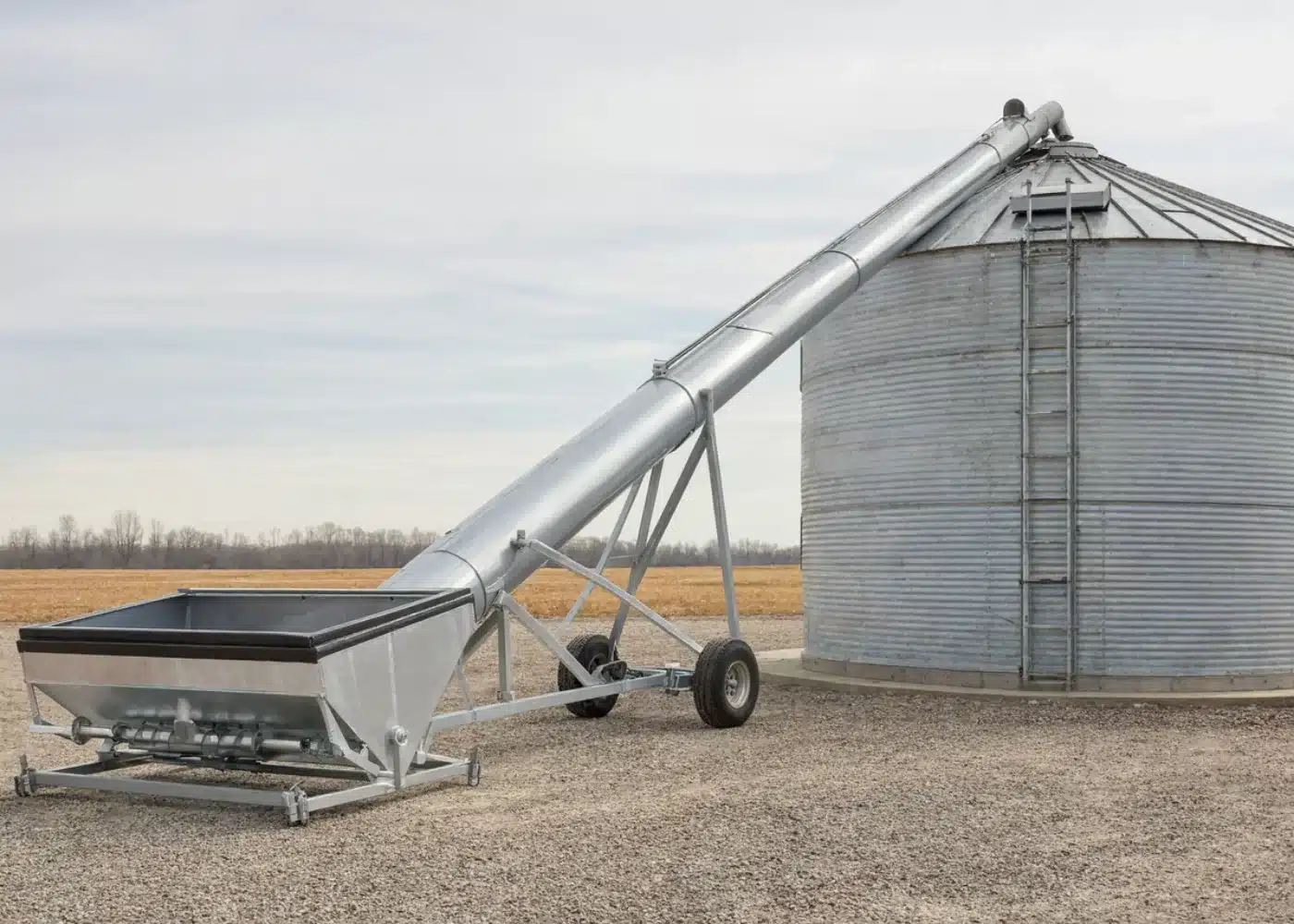
Portable augers, the easy part
A portable auger on a transport undercarriage is a genuinely good donation. It loads on a trailer, it sells to any grain farm, and the market is steady. Length and diameter are the two specs a buyer filters on.
Tell us the length and diameter, whether it is PTO driven or has an electric motor, and whether the flighting is worn. Also tell us whether the undercarriage wheels roll and whether the winch that raises it works.
Truck augers, drill fill augers, transfer augers and bin sweeps are all handled here too. If you have several, list them all on one form; they travel together.
Standing bins, and the honest math
A grain bin bolted to a concrete pad is a structure, not equipment. To have any value to a buyer it has to be unbolted sheet by sheet, sorted, stacked and hauled, and then re-erected at the other end. That is days of skilled labor with a crew and a lift.
For most bins under roughly ten thousand bushels, that labor exceeds what the steel and hardware return. The honest answer in those cases is that donating it will not produce a meaningful deduction and may not be viable at all. We would much rather tell you that now than after you have arranged anything.
Where it does sometimes work: a larger bin in good condition, a bin already dismantled and stacked on pallets, a bin being removed anyway by a contractor who can set the sheets aside, or several bins on one site where a crew mobilization makes sense. Tell us the bushel capacity, the diameter, the ring count, the roof and sheet condition, whether the floor and fans are included and whether it is still standing. We will run the numbers and give you a straight answer.
If the honest answer is no, a local bin removal contractor or a scrap steel buyer will often take it off your hands, sometimes at no cost to you. If you would rather the value go to the cause, sell it that way and donate the proceeds; we receipt that exactly the same.
What decides the number
- On an auger: length and diameter. The defining specs, and the common sizes sell fastest.
- On an auger: flighting and gearbox. Flighting wear at the intake is the main wear point. A working gearbox and a sound tube carry the sale.
- On an auger: undercarriage and winch. Whether it rolls and whether it raises. Both are expected to work.
- On a bin: whether it is standing or already down. By far the biggest factor. Dismantled and stacked is worth something; standing and bolted is usually a cost.
- On a bin: capacity, sheet condition and what is included. Roof condition, rust-through, dents, and whether the drying floor, fan, heater and unload system come with it.
Makes we accept
Both categories are brand-driven.
- Augers: Westfield MK and WR series, Sudenga, Hutchinson, Feterl, Mayrath, Farm King, Brandt, Batco and Convey-All belt conveyors, Buhler.
- Bins: Butler, Behlen, GSI, Sukup, Brock, Chief, MFS, Superior, Meridian and Westeel hopper bins.
- Bin equipment: Sukup and GSI drying floors and fans, Shivvers, Neco and Farm Fans dryers, bin sweeps from Sudenga and Hutchinson.
Manufacturer names appear here so you can find your own machine. No manufacturer sponsors, endorses or is affiliated with this program.
The paperwork, and what you can deduct
Farm equipment is not titled. Ownership is established with the purchase invoice, a bill of sale, a farm asset record, or a lien release if it was financed. Find the serial plate and photograph it. If the machine is part of an estate or a farm partnership, whoever signs needs authority to sign for it. A bin bolted to a foundation may also be treated as a fixture or real property rather than equipment depending on your state and how it is assessed, which changes the paperwork entirely. If yours is permanently affixed, tell us.
Giving Center sells the equipment and your deduction is the gross sale proceeds on Form 1098-C. A good portable auger commonly lands between $500 and $5,000, where Form 8283 Section A applies. A large conveyor or a bank of augers can clear $5,000.
On bins, be realistic: unless the bin is large, in good condition and already down or being taken down anyway, the likely outcome is under $500 or no viable donation at all. We will say so before anything is scheduled. Most farm equipment is a depreciated business asset, which makes a conversation with your accountant worth having before the pickup. Farm business property follows different rules than a personal donation.
Auger and bin donation questions
Can you take my grain bin?
Sometimes, and often the honest answer is no. A standing bin has to be unbolted sheet by sheet and that labor usually exceeds what the steel returns on anything under roughly ten thousand bushels. Tell us the capacity and condition and we will give you a straight answer first.
What if the bin is already dismantled and stacked?
Then it is genuinely much more viable, because the expensive part is already done. Tell us how it is stacked and what hardware came with it.
I have three bins on one site.
Better odds, because a crew mobilization makes more sense across three than one. Still depends on size and condition, and we will run the numbers.
Is the auger worth donating on its own?
Yes. A portable auger is a straightforward saleable item and an easy pickup. Give us the length and diameter.
Nobody will take my bin. What now?
A local bin removal contractor or a scrap steel buyer will often take it, sometimes at no cost to you. If you would rather the value fund the cause, sell it that way and donate the proceeds. We receipt that the same.
Giving Center does not provide tax, legal or financial advice. Donations are deductible to the extent allowed by law. See IRS Publication 526, Publication 561 and Publication 4303, and consult a tax professional.