
Compactor and roller donation
Donate a roller or compactor that outlasted the paving work
Compaction equipment is bought in sets and retired in pieces. A paving contractor keeps the machine that matches current bid work and ends up with a ride-on roller, two plate compactors and a rammer that no longer fit anything. All of them sell; none of them sell easily one at a time.
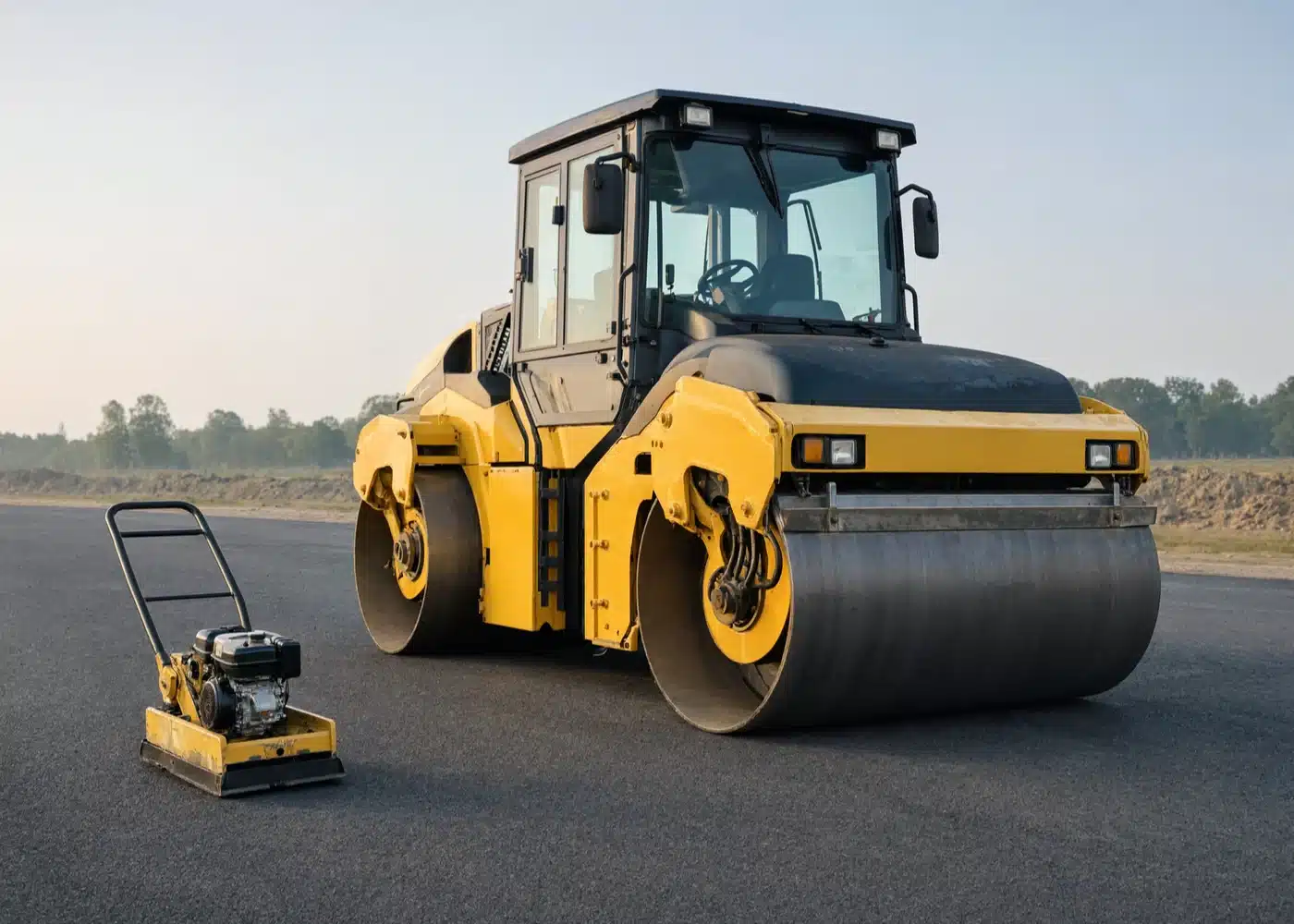
Where donated compaction equipment comes from
Paving and site-work contractors, municipalities, and rental yards. A tandem asphalt roller is replaced on a capital schedule. A smooth-drum soil compactor sits after the last big pad job. Small plate compactors and rammers pile up because they are too cheap to broker and too useful to scrap.
We accept both ends of the range. A ride-on double-drum roller is a real equipment sale. A pair of plate compactors and a jumping jack is a smaller sale but a very cheap haul, and the math still works.
Utility contractors send us trench rollers and remote-control compactors, which have a narrow but consistent buyer pool.
Sized to the machine, booked by us
A ride-on roller under about five tons fits a tilt-deck trailer. Larger soil compactors and padfoot machines go on a step-deck or lowboy. Walk-behind rollers, plate compactors and rammers can ride in a truck bed or on a small trailer, and several can travel together.
If you have more than one piece, group them. One trip for a roller plus three small compactors costs far less than four separate pickups, and the difference stays with the cause. List everything on the form.
Tell us whether the roller runs, whether the vibratory function works, and whether the drums are smooth or dented. Vibration is the usual failure and it changes what the machine is worth, not whether we accept it.
What decides what compaction equipment brings
- Drum width and weight class. The spec that defines the machine. A 48-inch tandem asphalt roller has a much wider market than an oddly sized one.
- Vibration and exciter condition. A roller that vibrates on both drums is a working machine. One that does not is a project, and priced that way.
- Drum surface. Dents, gouges and rust pitting on an asphalt drum matter because they print into the mat. On a soil compactor they matter much less.
- Hours and engine. Diesel rollers with modest hours and a clean start sell fastest. Small gas compactors are largely valued on whether they start and run.
- Quantity. Compaction gear sells better in lots. Several pieces together often bring more than the sum of the pieces sold apart.
Makes and models we accept
Rollers and compactors are searched by brand and drum size.
- Ride-on rollers: Caterpillar CB and CS series, Bomag BW series, Hamm and Wirtgen, Sakai SW and TW, Dynapac CC, Volvo DD and SD, Ingersoll Rand and Ammann, Case SV, Wacker Neuson RD.
- Walk-behind and trench: Wacker Neuson RT and RD, Bomag BMP, Multiquip, Rammax, Dynapac LP.
- Plate compactors and rammers: Wacker Neuson BS and DPU, Multiquip Mikasa, Bomag BP, Stone, Weber MT, Husqvarna, Northrock.
Not seeing yours? The list above is a search aid, not a restriction. We accept any make or model in this category, named here or not, including orphan brands and builders long out of business. What decides a donation is the condition and the paperwork, never the badge, so put yours on the form even if it is not listed.
Manufacturer names appear here so you can find your own machine. No manufacturer sponsors, endorses or is affiliated with this program.
The paperwork, and what you can deduct
None of this equipment is titled. A bill of sale, the purchase invoice or a company asset record proves it is yours. Serial numbers off each machine go on the paperwork, and if you are donating several we itemize them.
Giving Center sells the equipment and your deduction is the gross proceeds, reported on Form 1098-C. A late-model ride-on roller can clear $5,000, which requires a qualified appraisal and Form 8283 Section B, at your expense and by your choice. Most single plate compactors and rammers sell well under $500, where the deduction is the lesser of fair market value or $500 with a written acknowledgment instead of a 1098-C.
When several items are donated together, the IRS looks at similar items as a group for the reporting thresholds. Your accountant will want the itemized list, which is why we produce one.
Compactor and roller donation questions
Is a single plate compactor worth donating?
On its own the deduction will be small, under $500 in most cases. If you have several pieces, or a roller going at the same time, it is worth adding to the same pickup.
Will you take a roller that does not vibrate?
Yes. It sells as a static roller or a repair project. Say so on the form so the listing is honest.
Do you take asphalt paving equipment too?
Tell us what you have. Pavers, screeds and milling machines are handled case by case through the construction equipment form.
Can several pieces go on one pickup?
Yes, and it is the better outcome. One trip costs less, and what is saved on transport stays with the cause.
What about a towable roller with no engine?
Still saleable. Pull-behind and towed rollers have a buyer pool among farms and grading contractors.
Giving Center does not provide tax, legal or financial advice. Donations are deductible to the extent allowed by law. See IRS Publication 526, Publication 561 and Publication 4303, and consult a tax professional.