
Car donations
Donate an electric car
One number decides what an EV is worth, and it is not the mileage. Tell us the battery's state of health and we can tell you quickly whether donating makes sense.
What an electric car is worth now
Used EV values have fallen further and faster than the rest of the market, and a car that cost fifty thousand dollars six years ago can be worth a small fraction of that today. That is not a comment on the car. It is new-model range, falling new prices and buyer caution about batteries, all pushing the same direction.
The number buyers ask about first is battery state of health. A late-model EV with a healthy pack sells readily. An early short-range car with a degraded pack commonly falls under $500, and we would rather tell you that before the tow than have you find it on the Form 1098-C. It is still a donation worth making if what you want is the car gone and the value put to use. It is not a donation worth making if you are expecting a large deduction.
Battery state of health, and how to report it
Send us whatever your car will tell you. Most EVs show a state-of-health percentage in a service menu, a connected app, or through an inexpensive third-party reader. If yours does not, charge it to 100% and photograph the estimated range on the dash. That figure against the original EPA range is enough for us to work with.
- State of health percentage, if the car reports one.
- Indicated range at a full charge, and the original rated range.
- Whether the pack or any modules have been replaced, and when.
- Any open recall or completed warranty work on the pack or charging system.
- Whether the capacity warranty is still in force and whether it transfers to a new owner.
A pack under an active transferable capacity warranty is worth materially more than the same pack out of warranty, so this is worth checking rather than guessing.
What you have to tell us before we schedule
This is the one requirement on the page we will not compromise on, and it is a safety matter rather than a paperwork one. Before a truck is booked you must tell us about any thermal event, fire, smoke, coolant loss, pack warning light, flood or water exposure, collision affecting the underbody, or open pack-related recall.
A damaged high-voltage pack needs specialized handling, a specific kind of transport and a yard prepared to receive it, and some will not accept one at all. Told in advance, it is straightforward. Discovered on a driveway, it is dangerous and the pickup stops.
- Do not open, disconnect, service or attempt to test the high-voltage pack yourself.
- Do not charge a car that has shown a thermal warning or smells of coolant.
- Electric cars must not be flat-towed on the drive wheels. Flatbed only.
- If the car will not wake or cannot be shifted out of park, say so — it changes the equipment we send.
Charging equipment and accessories
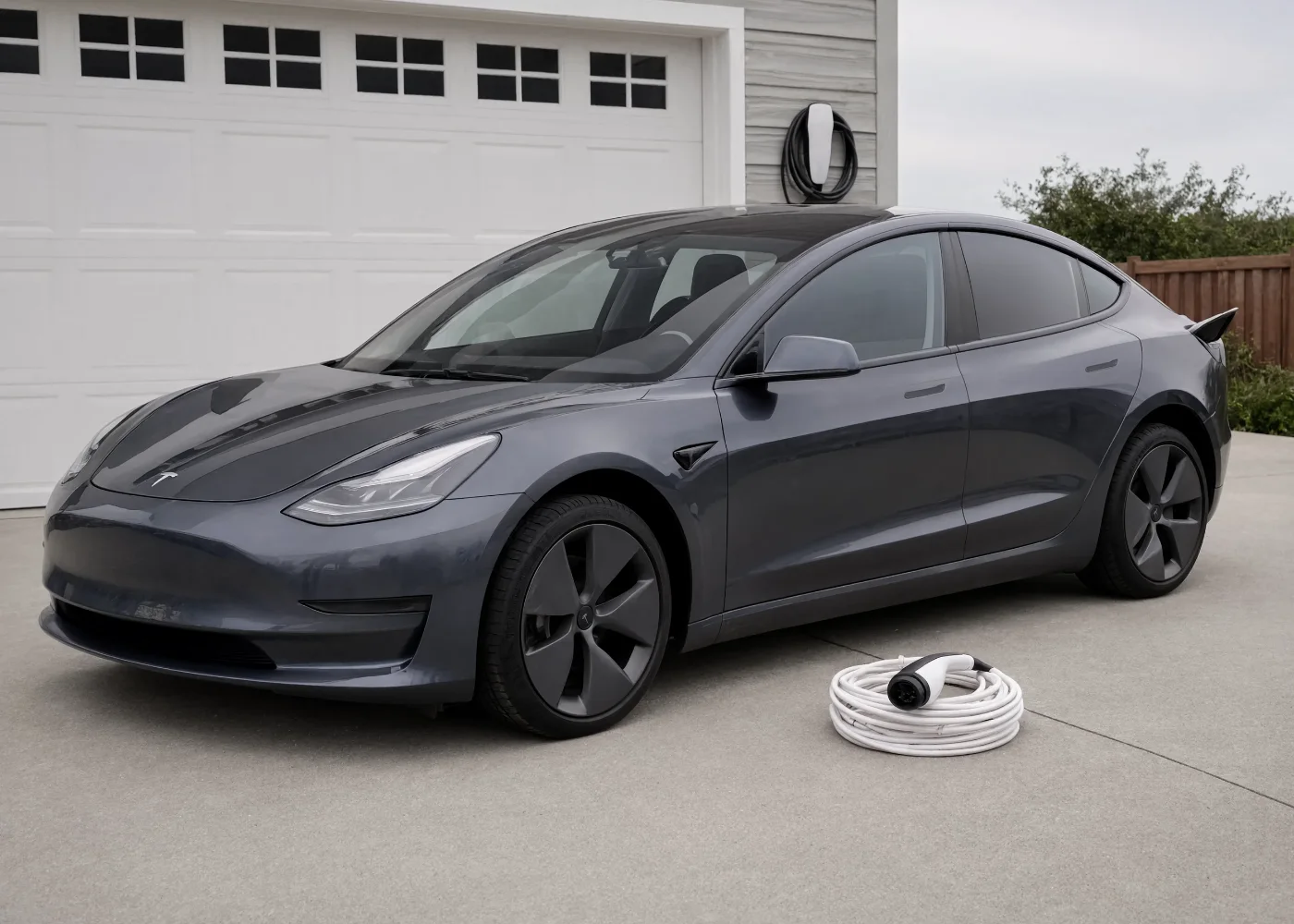
Send everything electrical that came with the car: the mobile connector, any adapters, the charge-port cover, and every key, card or fob. A missing mobile connector and a single key knock real money off an otherwise good EV, more than the parts cost to replace, because a buyer prices in the hassle.
A portable wall unit can come with the car if you want it to. A hardwired wall charger generally stays with the house as a fixture, and is not part of the vehicle donation.
Accounts, software and subscriptions
Before the car is picked up, remove it from your manufacturer account, cancel or transfer connectivity subscriptions, run a factory reset on the infotainment and clear the saved home address and paired phones. A car still tied to a previous owner's account is a genuine problem for a buyer and a delay for the sale.
Worth knowing: some paid features and software upgrades do not transfer to a second owner. Buyers in this market know exactly which ones, so it is better to tell us what the car has and let us describe it accurately than to have it discovered at inspection.
How the deduction works
When we sell the car, your deduction is the gross proceeds of that sale, reported to you on Form 1098-C. It is not what you paid, not what you spent on it, and not a number anyone here is going to quote you in advance.
If you claimed a clean vehicle credit when you bought the car, that is a separate matter from a charitable deduction. Ask your accountant how disposing of the car interacts with it before you donate, because we cannot advise on it.
If you intend to claim more than $5,000 you will need a qualified appraisal. That is your expense and your choice, not something we arrange or pay for.
Getting it on a truck
Flatbed, always. Leave 30 to 50 percent charge in the pack if you can — enough for the car to wake, release the parking brake and move under its own power onto the deck, which is easier on the car than winching it. If the car is fully discharged and bricked, tell us; a dead EV that cannot be shifted to neutral needs specific equipment.
Leave the twelve-volt battery connected. On many EVs a flat twelve-volt battery locks the car out entirely, doors included.
Makes we accept
Tesla, Nissan, Chevrolet, Ford, Hyundai, Kia, BMW, Volkswagen, Audi, Rivian, Polestar, Volvo, Mercedes-Benz, Porsche, Jaguar, Lucid, Mini, Fiat, Mitsubishi, Toyota, Subaru, Honda, Cadillac, Genesis and others, including makes no longer trading. An orphaned brand with no parts supply is worth less and we will say so, but we still accept it.
Not seeing yours? The list above is a search aid, not a restriction. We accept any make or model in this category, named here or not, including orphan brands and builders long out of business. What decides a donation is the condition and the paperwork, never the badge, so put yours on the form even if it is not listed.
No manufacturer listed here sponsors, endorses or is affiliated with this program. Names are used only to describe what we accept.
Electric car questions
How much range does it need to have?
There is no cutoff. More range means a better sale and a better deduction, and a car with very little range left is worth very little. Send us the state of health figure and we will be straight with you about what to expect.
It will not charge at all. Do you still want it?
Yes, but read the page on an EV with a failed battery first. A car with a dead pack is close to parts value, and the deduction will reflect that.
Do you need the charging cable?
Please send it, along with every key. The pair together are worth more than they cost, because a buyer discounts harder than the replacement price.
Can you tow it with a rope or a dolly?
No. Electric cars must not be flat-towed on the drive wheels. We move them on a flatbed.
What about the clean vehicle credit I claimed?
That is a question for your accountant, not for us. It is separate from the charitable deduction and we are not in a position to advise on how a disposal affects it.
Giving Center does not provide tax, legal or financial advice. Donations are deductible to the extent allowed by law. See IRS Publication 526, Publication 561 and Publication 4303, and consult a tax professional.