
Antique tractor donation
Donate an antique tractor to the collectors who restore them
Antique tractors are a collector market rather than a working-equipment market, and that changes everything. Originality matters more than condition, completeness matters more than whether it runs, and a rough honest tractor from a barn is often worth more than a repainted one.
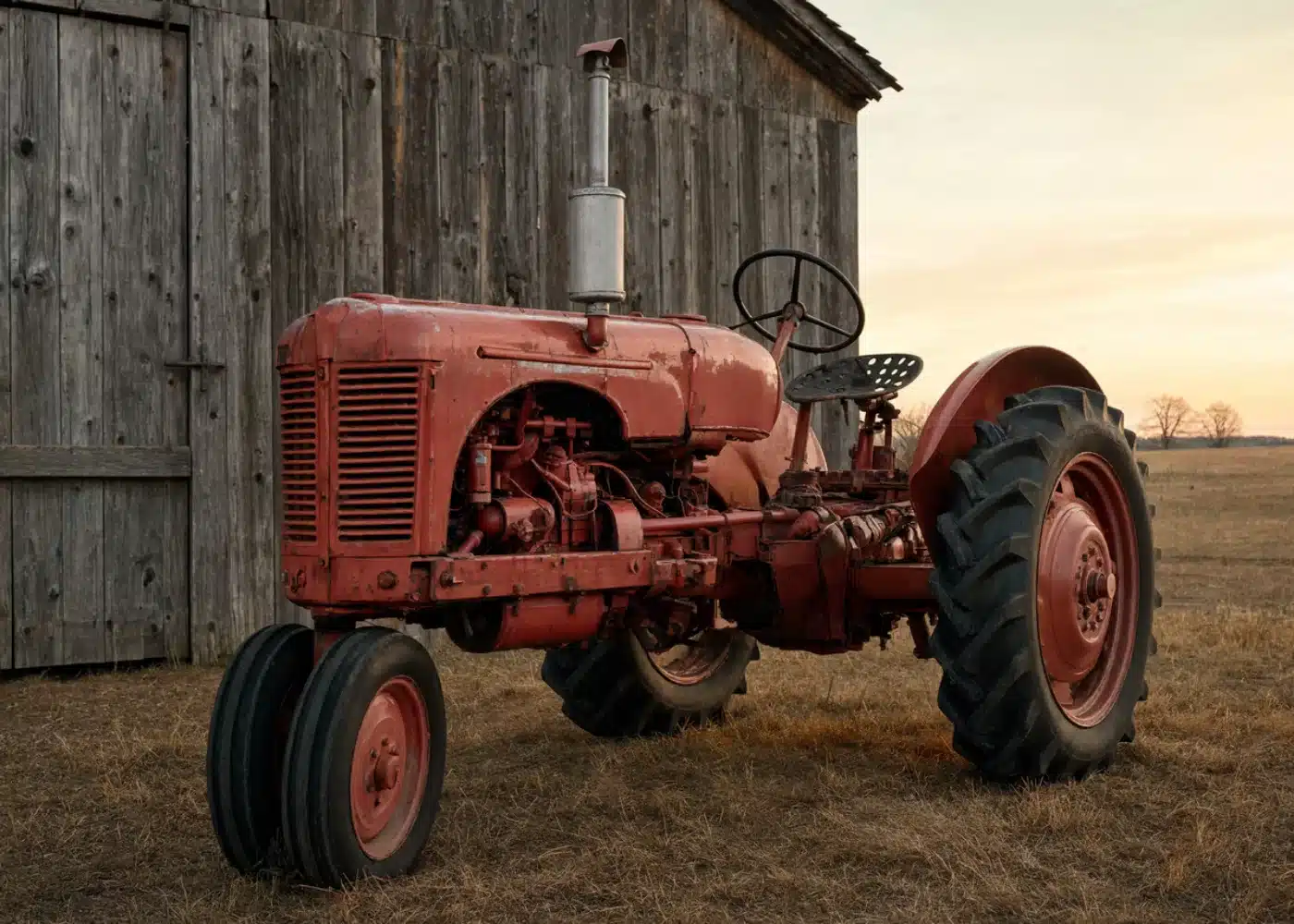
Where donated antique tractors come from
Farm families clearing a property. An antique tractor behind a barn has usually been there for forty years and the family has no idea whether it is worth two hundred dollars or five thousand.
Estates, very often, and collectors thinning a group. If you have several, tell us: they travel together on one trailer and the saving stays with the cause.
Owners who bought one to restore and never started. Those come with a tractor and often a pile of new correct parts, which is worth sending along.
On a trailer, exactly as it sits
An antique tractor rides on a tilt-deck or a small equipment trailer. It does not need to run. Inexpensive haul.
Tell us whether the engine turns over by hand, whether the wheels roll and whether the brakes release. Tractors that have sat on dirt for decades often have seized brakes and rotted tires, which means skates and a winch.
Do not restore it, repaint it or clean it up. On antique tractors this matters more than almost anywhere: original paint and original decals are worth real money, and a fresh coat of the wrong shade of red actively lowers the sale. Leave it. Do not throw anything away either, including broken original parts.
What decides what an antique tractor brings
- Model and rarity. The dominant factor and the range is enormous. Certain models are worth many times others of similar size and age.
- Originality and completeness. Original sheet metal, grille, hood, fenders, seat, magneto and correct carburetor. Missing sheet metal is the hardest thing to source.
- Whether it turns over. A free engine is a real premium. A complete seized tractor is still genuinely saleable.
- Original paint and decals. Worth more than a repaint in current markets. Do not spray it.
- Documentation. Original manuals, a serial number that decodes to something notable, or known ownership history all add.
Makes we accept
This is a purely model-driven collector market, so identify it exactly.
- International and Farmall: Farmall A, B, C, H, M, Super A through Super MTA, 300, 400, 450, Cub, and the 06 and 56 series.
- John Deere two-cylinder: A, B, G, H, D, M, 40, 50, 60, 70, 320, 420, 520 through 830, and the New Generation 1010 through 5010.
- Others: Ford 9N, 2N, 8N, Jubilee and hundred series, Allis-Chalmers WC, WD, WD45, B, C and D series, Oliver 66, 77, 88 and Super series, Massey Harris and Massey Ferguson 35 and 65, Minneapolis-Moline, Case VAC and DC, Cockshutt, Silver King.
Manufacturer names appear here so you can find your own machine. No manufacturer sponsors, endorses or is affiliated with this program.
The paperwork, and what you can deduct
Farm equipment is not titled. Ownership is established with the purchase invoice, a bill of sale, a farm asset record, or a lien release if it was financed. Find the serial plate and photograph it; that number goes on the paperwork. If the machine is part of an estate or a farm partnership, whoever signs needs authority to sign for it. On a tractor this old the serial plate may be unreadable or gone, which is common and usually fine because these are not titled. Photograph whatever is there.
Giving Center sells the tractor and your deduction is the gross sale proceeds on Form 1098-C. A desirable original model in running condition can clear $5,000, where the IRS requires a qualified appraisal and Form 8283 Section B at your expense. Most antique tractors land between $500 and $5,000, where Section A applies with no appraisal.
A rough incomplete tractor of a common model may sell under $500, where the deduction is the lesser of fair market value or $500 with a written acknowledgment. But do not assume that is where yours sits, because this is the farm category where families most often guess low and are wrong.
Antique tractor donation questions
Should I paint it before donating?
No. Please do not. Original paint outsells a repaint in this market and the wrong shade actively lowers the value.
It has been sitting in a fencerow since the eighties.
That is the classic version of this donation and it is perfectly saleable. Do not try to start it. Tell us whether the engine turns by hand and whether the wheels roll.
The sheet metal is rough and one fender is missing.
Worth disclosing carefully, because sheet metal is the hardest thing to replace on these. Keep every original piece even if damaged.
I have three of them.
Tell us the count. They travel together on one trailer and that keeps transport cost down considerably.
How do I find out what model it is?
Look for a cast-in model designation on the transmission housing or a serial plate on the dash or frame rail, and photograph it. The exact model is most of the value.
Giving Center does not provide tax, legal or financial advice. Donations are deductible to the extent allowed by law. See IRS Publication 526, Publication 561 and Publication 4303, and consult a tax professional.